
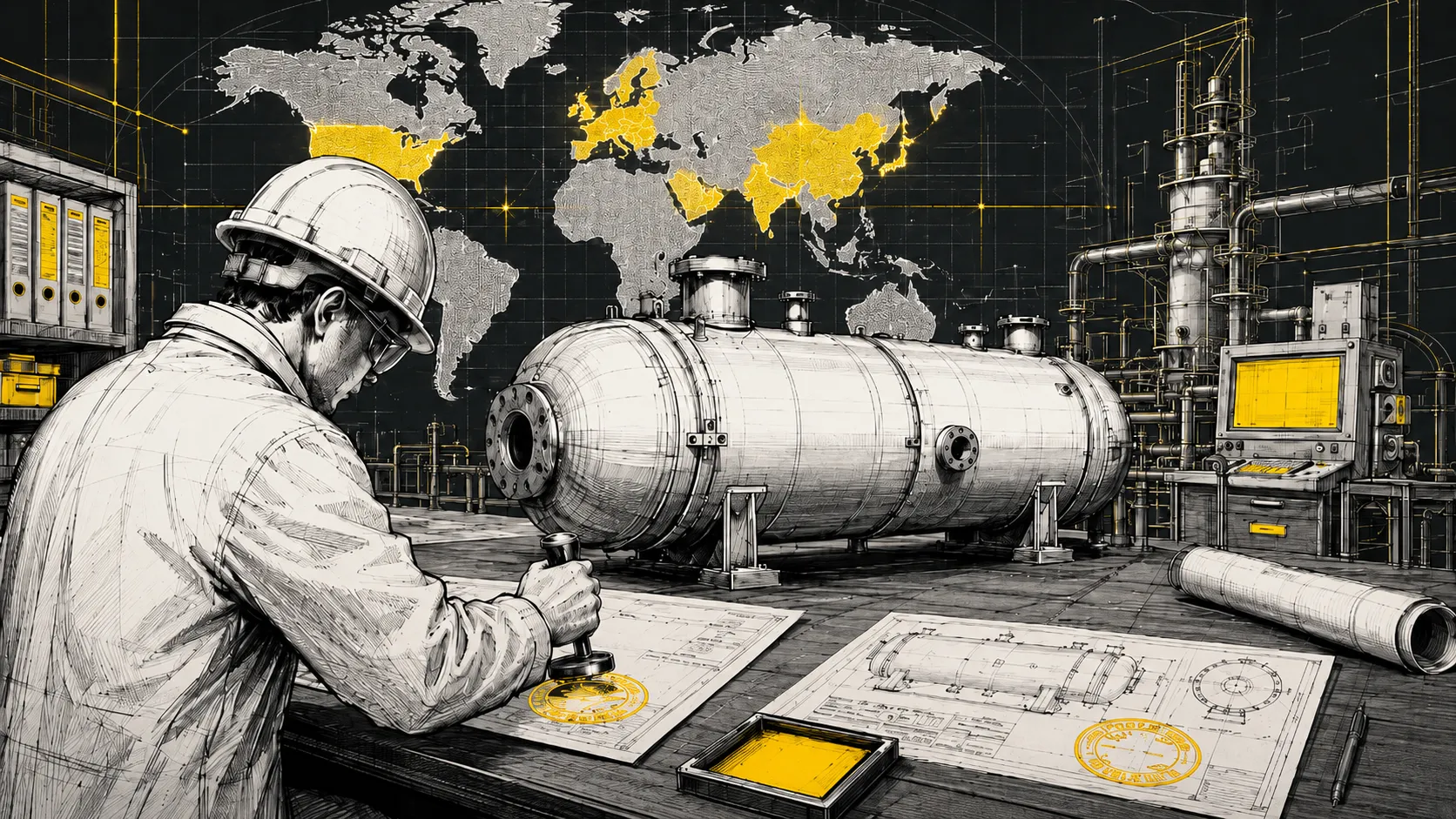
How Pressure Vessel Inspection Actually Works Across Different Countries
A pressure vessel designed to ASME Section VIII is not automatically legal to build, import, or operate anywhere in the world. The design code and the regulatory approval to actually put the vessel into service are two separate things, and the gap between them is where a significant amount of EPC project risk sits. Every country that hosts process plants has built its own layer on top of, or alongside, the major international design codes, usually through a statutory body, a licensing office, or a network of authorized inspectors. For an engineer moving between projects in different regions, understanding that layer matters as much as understanding the code itself.
This post walks through how that regulatory layer is structured in the markets where most industrial EPC work actually happens, and closes with a short note on why this matters for how we think about AI in engineering compliance.
United States: a code maintained by one body, enforced by another
ASME's Boiler and Pressure Vessel Code is the design and construction standard, but ASME itself is not the enforcement authority. That role sits with individual state and municipal jurisdictions, most of which have adopted the code into law through their own boiler and pressure vessel safety acts. Each jurisdiction maintains a Chief Inspector's office responsible for registering vessels and enforcing compliance within its borders.
Sitting between the code and the jurisdictions is the National Board of Boiler and Pressure Vessel Inspectors, which maintains the National Board Inspection Code covering in-service inspection, repair, and alteration once a vessel is already operating. Actual certification work, meaning the shop inspections that allow a manufacturer to stamp a vessel, is carried out by Authorized Inspectors, who are typically employed by insurance companies or independent inspection agencies rather than by ASME or the National Board directly. This three-layer structure, code body, jurisdictional authority, and authorized inspector, is the model most other countries have either adapted or explicitly diverged from.
The European Union: one directive, many notified bodies
The EU takes a different approach, built around the Pressure Equipment Directive rather than a single design code. PED sets the essential safety requirements that pressure equipment must meet before it can carry the CE mark and be placed on the EU market, but it does not prescribe a specific calculation method the way ASME does. Manufacturers typically design to a recognized standard, EN 13445 for unfired pressure vessels being the most common, and then go through conformity assessment with an independent Notified Body.
Notified Bodies are accredited by individual member states but operate across the entire EU market. TÜV SÜD, TÜV Rheinland, TÜV Nord, Bureau Veritas, DNV, and Lloyd's Register are among the most active in this role, and a manufacturer can generally choose which Notified Body to work with rather than being tied to the country where the equipment is built. This is a meaningfully different model from the US system, where jurisdiction is tied to geography rather than a chosen certifying party.
The United Kingdom: a split system after Brexit
The UK left the PED framework after Brexit and introduced its own Pressure Equipment (Safety) Regulations, which initially pointed toward a separate UKCA marking scheme administered by UK Approved Bodies rather than EU Notified Bodies. In practice, the picture has settled somewhere in between. Under regulations finalized in 2024, the UK now recognizes CE marking indefinitely for most stationary pressure equipment sold into Great Britain, which means a manufacturer with valid PED certification generally does not need a separate UKCA process for that category. Transportable pressure equipment, such as cylinders and tanks, is treated differently and still requires UKCA or the Pi marking scheme specifically. Northern Ireland follows a further separate arrangement under the Windsor Framework, accepting both CE and UKCA. It is a system with more moving parts than it first appears, and the details matter depending on whether the equipment in question is stationary plant kit or something that moves across borders.
Saudi Arabia and the Gulf: code plus operator standards plus national regulator
In Saudi Arabia and much of the Gulf, ASME Section VIII remains the dominant base design code for pressure vessels, but it rarely stands alone. The Saudi Standards, Metrology and Quality Organization, SASO, is the national regulator responsible for product conformity and operates the SABER platform for certain equipment categories. Layered on top of that, major owner-operators such as Saudi Aramco and SABIC maintain their own engineering standards, commonly referred to as SAES specifications, which supplement ASME and API requirements with additional material, welding, and inspection requirements specific to that operator's assets and service conditions.
This creates a structure where the design code, the national regulator, and the owner's internal standards all apply simultaneously, and a vessel built for a Saudi Aramco facility is realistically being checked against three overlapping sets of requirements rather than one. Third-party inspection remains a standard part of this process, both to satisfy SASO and to satisfy the operator's own quality assurance requirements.
India: two regulators depending on what the vessel does
India runs a genuinely two-track system that is easy to get wrong if you are not familiar with it. The Indian Boiler Regulations, administered by the Central Boilers Board and enforced through each state's Chief Inspector of Boilers, apply specifically to boilers and to any vessel in which steam is generated, along with associated piping and fittings. This framework dates back to the Boilers Act, 1934 and remains one of the more strictly enforced import certification regimes in the world, requiring independent design appraisal and welder certification for any boiler component entering the country.
Pressure vessels that do not generate steam typically fall outside IBR entirely and are instead built to IS 2825 or to a client-specified code such as ASME Section VIII, with the Petroleum and Explosives Safety Organisation, PESO, taking regulatory responsibility for categories like static and mobile pressure vessels used for LPG and other hazardous gases. Knowing which of these two regulatory paths applies to a given piece of equipment, boiler regulation or general pressure vessel practice, is one of the more common sources of confusion for teams unfamiliar with the Indian market.
China: a licensing system, not just a design code
China's system is built around the concept of special equipment, a legal category that includes boilers, pressure vessels, pressure piping, and several other equipment types. The State Administration for Market Regulation oversees this through its Special Equipment Licensing Office, commonly known as SELO, which administers the TSG series of safety technology regulations alongside the national GB standards.
A manufacturer wanting to build or sell pressure vessels into China needs a China Manufacture License, sometimes called the SELO license or China stamp, which is a manufacturing and quality-system approval rather than a per-project design check. Where a project specifies an international design code instead of Chinese standards, SELO has a formal pathway for this: the manufacturer submits a Conformity Declaration and comparison table demonstrating that the international code meets the essential safety requirements of the relevant Chinese technical regulation. This is a materially different structure from the US or EU model, since the primary approval is tied to the manufacturer's licensed status rather than to a Notified Body's project-specific sign-off.
Japan and Korea: gas safety law and labor safety law running in parallel
Japan splits pressure equipment regulation across two separate legal frameworks that trace back to different government ministries. The High Pressure Gas Safety Act, administered through the High Pressure Gas Safety Institute of Japan, known as KHK, and overseen by the Ministry of Economy, Trade and Industry, governs equipment used in high-pressure gas processes. Separately, the Ministry of Health, Labour and Welfare maintains its own construction code for boilers and pressure vessels under Japan's labor safety legislation. Since 2003, KHK's framework has formally recognized ASME code equipment as meeting its designated equipment inspection standards, which has made it considerably more workable for foreign manufacturers than it once was, but the underlying point remains that a project in Japan may need to satisfy two distinct regulatory lines depending on how the equipment is classified.
South Korea's system runs through the Korea Gas Safety Corporation, KGS, a government-affiliated body under the Ministry of Trade, Industry and Energy. KGS traces its origins back to Korea's 1974 Compressed Gas Control Law and today handles manufacturer approval, product certification, and inspection for pressure equipment, with its scope having expanded further in recent years to cover hydrogen storage and refueling equipment under Korea's Hydrogen Act. Korea also maintains its own construction code, KEPIC, used primarily in power generation projects, which exists alongside rather than instead of ASME-based design for much of the wider industrial sector.
The rest of the field, briefly
A few other systems are worth knowing at a glance. Australia regulates pressure equipment at the state level rather than nationally, through bodies such as SafeWork NSW and WorkSafe Victoria, referencing the AS 1210 pressure vessel standard. Canada uses a provincial registration system built around the Canadian Registration Number, where each province's safety authority, such as the Technical Standards and Safety Authority in Ontario, registers a design against CSA B51 before a CRN is issued for that jurisdiction, and a design generally needs a separate CRN in each province where it will be installed. Brazil enforces pressure vessel safety through NR-13, a labor ministry regulation requiring periodic inspection by a licensed engineer, applied on top of ASME-based design in most industrial settings.
The pattern underneath all of this
Looked at together, these systems share a common structure even where the details diverge sharply. There is almost always a base design code, frequently ASME Section VIII or a regional equivalent like EN 13445, sitting underneath a statutory or licensing layer specific to the country, which is in turn checked by some form of independent inspection, whether that is an Authorized Inspector, a Notified Body, or a government-affiliated corporation like KGS or KHK. What differs is where the real friction sits. In the US and EU, it tends to sit with choosing and coordinating the right certifying body. In India and China, it sits with correctly classifying which regulatory track a piece of equipment falls under. In Saudi Arabia and the wider Gulf, it sits with reconciling operator-specific standards against the base code and the national regulator at the same time.
For an EPC firm running projects across several of these regions simultaneously, this is not a small administrative detail. The same vessel design can require materially different documentation, different named calculation references, and different inspection sign-offs depending purely on where it is being installed, even when the underlying engineering has not changed at all.
Where this connects to our work
This is a large part of why we built DeepMechanix around the ASME calculation set specifically, rather than trying to encode every national variant at once. The underlying design math, shell thickness, nozzle reinforcement, MDMT determination, stays consistent across most of these regimes even when the enforcing body and the paperwork around it does not. Our view is that getting the base calculation layer fully traceable and code-cited first is what makes it realistic to extend into the jurisdictional layer on top of it, rather than trying to solve both problems at once.